
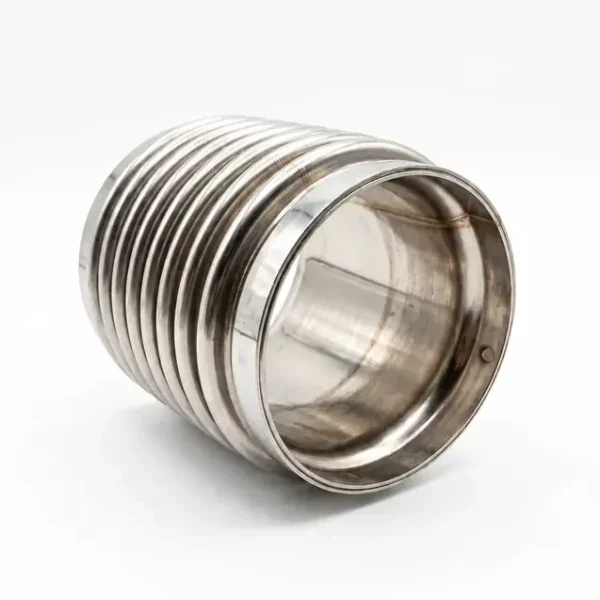
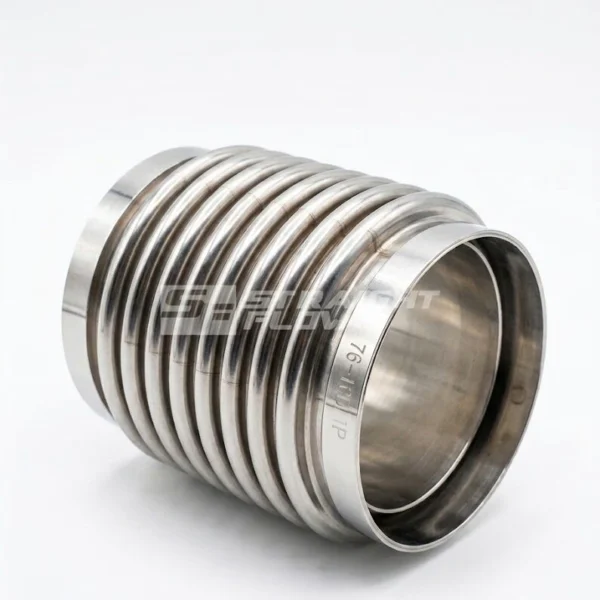
Straightflow offers universal exhaust flex pipes for vehicle repairs, custom exhaust fabrication and performance applications. Choose from Inner Braid, InterLock and stainless steel mesh flex pipes in a wide range of diameters and lengths for reliable vibration and thermal expansion control.
[sf_more]
Exhaust Flex Pipes and Flexible Exhaust Joints
An exhaust flex pipe creates a flexible connection between rigid sections of an exhaust system. The engine moves during acceleration, braking and gear changes. In addition, exhaust components expand as their temperature rises. A flexible joint absorbs part of this movement before it reaches the remaining system.
Without enough flexibility, the exhaust system may place excessive force on manifolds, downpipes, catalytic converters and welded connections. Consequently, cracks, leaks and broken mounting points may develop over time.
Straightflow supplies universal flexible exhaust pipes in many diameters and lengths. The category includes inner braid, InterLock and stainless steel mesh braid designs. Therefore, fabricators can choose a suitable construction for everyday repairs, diesel applications, turbocharged vehicles and custom exhaust systems.
What Does an Exhaust Flex Pipe Do?
An exhaust flex pipe allows controlled movement between two rigid pipe sections. It does not replace an exhaust hanger or engine mount. Instead, it works together with the vehicle’s mounting system to reduce mechanical stress.
A correctly installed flexible pipe can help:
- Absorb engine and gearbox movement
- Reduce vibration through the exhaust system
- Allow for thermal expansion
- Protect manifolds and turbo downpipes
- Reduce stress on catalytic converters
- Protect welded joints against fatigue
- Limit vibration transfer into the vehicle body
- Extend the service life of connected components
However, the flex pipe must match the diameter and movement requirements of the system. An unsuitable or poorly positioned joint may fail early.
Exhaust Flex Pipe as an Expansion Joint
Many technicians also call a flex pipe an exhaust expansion joint. Both terms describe a component that allows limited movement between rigid exhaust sections.
As the exhaust heats up, metal pipes expand. Later, they contract again while cooling. Meanwhile, the engine moves independently from the vehicle body. The expansion joint helps manage both types of movement.
For this reason, exhaust flex pipes commonly appear near:
- Exhaust manifolds
- Turbocharger downpipes
- Front exhaust sections
- Catalytic converters
- Diesel particulate filters
- Transverse engine exhaust systems
The installer should position the flex pipe where it can absorb movement without carrying the weight of the exhaust system.
Inner Braid Flex Pipes
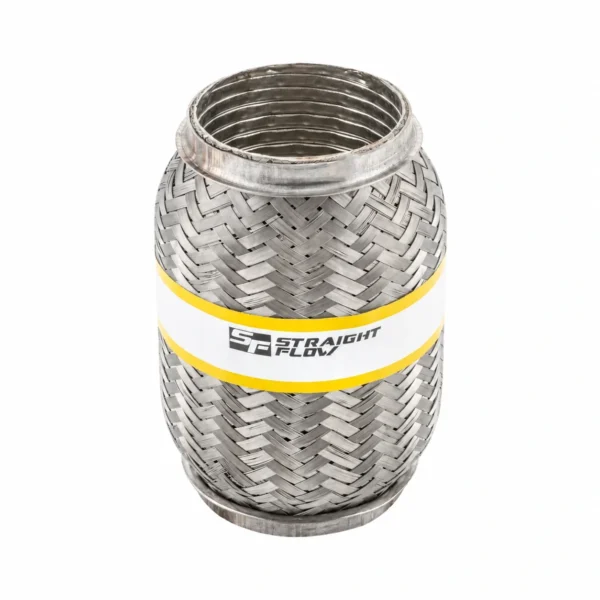
An inner braid flex pipe uses a woven metal braid inside the flexible section. This construction protects the external bellows and creates a smoother internal surface than an unlined design.
Straightflow offers Inner Braid HD flex pipes in different diameters and lengths. These products suit general exhaust repairs and many standard road applications. :contentReference[oaicite:1]{index=1}
The internal braid helps guide the exhaust gases through the flexible joint. In addition, it reduces direct exposure of the bellows to the exhaust flow. Therefore, the design provides a practical balance between flexibility, durability and price.
InterLock Flexible Exhaust Pipes
An InterLock flex pipe contains an interlocking metal liner inside the flexible section. The liner creates a smoother and more protected exhaust path. As a result, it can reduce turbulence and shield the outer bellows from direct exhaust gas contact.
Straightflow lists InterLock VW flexible pipes in several diameters and lengths. The current range includes products for common passenger car and larger exhaust pipe sizes. :contentReference[oaicite:2]{index=2}
InterLock flex pipes often suit demanding applications where the system produces strong pulsation, vibration or high exhaust flow. For example, workshops may use them in turbocharged, diesel and performance exhaust systems.
However, “VW” in the product line does not necessarily mean that every part provides direct vehicle-specific fitment. Always confirm the actual dimensions before ordering.
Stainless Steel Mesh Braid Flex Pipes
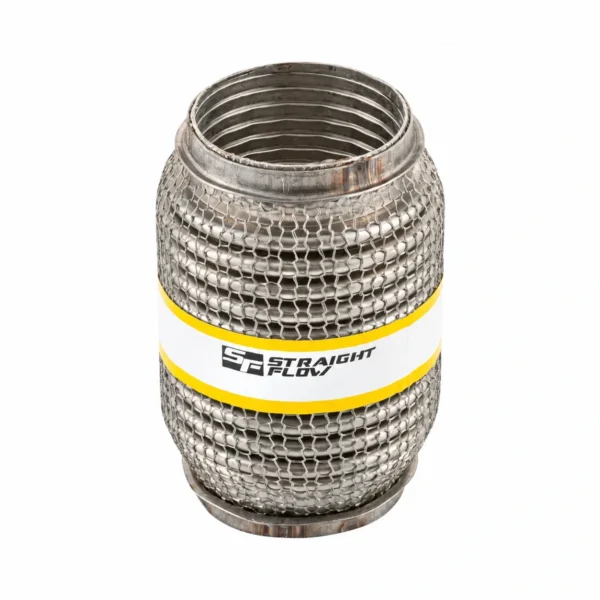
A mesh braid flexible pipe uses stainless steel braiding around the outside of the flexible bellows. Straightflow lists these products under the SuperFlex and Mesh Braid SS range. :contentReference[oaicite:3]{index=3}
The external braid protects the bellows and helps control its movement. Moreover, stainless steel construction offers good resistance to heat, moisture and road conditions.
Mesh braid flex pipes suit many repair and custom fabrication projects. Nevertheless, the internal design may differ between products. Therefore, check whether the selected model also includes an inner braid or InterLock liner.
Inner Braid vs InterLock Flex Pipe
Both constructions provide flexibility, but they use different internal liners.
- Inner braid flex pipes use a woven metal braid inside the bellows.
- InterLock flex pipes use an interlocking metal liner with a smoother internal surface.
An inner braid design suits many everyday repairs and standard exhaust systems. In contrast, an InterLock liner may suit applications with stronger exhaust flow, higher vibration or demanding operating conditions.
However, construction alone does not determine suitability. Diameter, length, flexibility and installation position also affect performance and service life.
How to Choose the Correct Flex Pipe Diameter
First, measure the outside diameter of the exhaust pipe. Then, compare that measurement with the connection diameter shown on the product page.
Do not estimate the size by eye. Common exhaust diameters can differ by only a few millimetres. Therefore, use a calliper or another accurate measuring tool.
Before ordering, check:
- Exhaust pipe outside diameter
- Flex pipe connection diameter
- Flexible section length
- Total product length
- Available installation space
- Required internal construction
- Welding or clamping method
The connection ends should match the planned fabrication method. For example, a workshop may butt-weld the joint, sleeve it over a pipe or use an additional connector.
How to Choose the Correct Flex Pipe Length
The product length usually includes both the flexible section and the rigid connection ends. Therefore, check both measurements instead of relying only on the number in the product name.
A longer flexible section can generally absorb more movement than a very short one. However, excessive length may allow too much movement or may not fit the available space.
Choose a length that allows the joint to remain close to its natural position after installation. Do not stretch, compress or bend the flex pipe aggressively to make it fit.
Flexible Section Length vs Total Length
The flexible section length describes the active braided or bellows area. In contrast, the total length also includes the rigid end connections.
This distinction matters during repair work. If the technician removes a damaged section that measures 200 mm, a flex pipe with a 200 mm flexible area may have a much greater total length.
Therefore, measure the complete replacement area before cutting the existing exhaust pipe.
Where Should You Install an Exhaust Flex Pipe?
Install the flex pipe close enough to the engine to absorb movement, but avoid areas with excessive heat or direct contact with other components.
The joint should sit in a relatively straight pipe section. In addition, the exhaust hangers should support the weight of the remaining system.
A suitable installation should provide clearance from:
- The vehicle floor
- Drive shafts and axles
- Suspension components
- Fuel and brake lines
- Heat-sensitive panels
- Road surfaces and obstacles
Most importantly, the flex pipe should absorb movement rather than support exhaust weight.
Correct Flex Pipe Installation
First, support the exhaust system in its normal position. Next, remove the damaged section without forcing the surrounding pipes out of alignment. Then, position the new flex pipe in a neutral state.
During installation:
- Keep the flex pipe aligned with the exhaust route
- Avoid twisting the flexible section
- Do not install it fully stretched
- Do not compress it excessively
- Keep welding heat away from the braid
- Support the exhaust before completing the welds
- Check clearance after installation
Afterward, inspect the engine mounts and exhaust hangers. Damaged mounts can create excessive movement and quickly destroy the new flexible joint.
Can You Weld an Exhaust Flex Pipe?
Yes. Professional exhaust fabricators commonly weld universal flex pipes into the exhaust system. MIG and TIG welding can both work, depending on the materials and workshop equipment.
Before welding, clean the connection ends and confirm the alignment. In addition, protect the braided section from sparks and excessive heat.
Complete the weld around the rigid connection ends only. Do not weld directly onto the flexible braid or bellows.
Can You Clamp a Flexible Exhaust Pipe?
Some installations may use sleeves and exhaust clamps. However, the selected flex pipe must have suitable connection ends for that method.
A welded connection usually creates a compact and permanent repair. In contrast, a clamped connection can simplify future removal. Nevertheless, poor clamping may allow leaks or movement.
Therefore, choose the installation method according to the product dimensions, pipe layout and intended use.
Signs of a Failed Exhaust Flex Pipe
A damaged flexible exhaust pipe can create both noise and movement problems.
Common symptoms include:
- A blowing or hissing exhaust sound
- Metallic rattling under the vehicle
- Visible damage to the external braid
- Soot marks around the flexible section
- Exhaust smell near the engine bay
- Increased vibration inside the vehicle
- Cracks around the connection welds
However, similar symptoms can come from damaged gaskets, manifolds or nearby pipe sections. Therefore, inspect the complete front exhaust system before replacing the flex pipe.
Why Do Exhaust Flex Pipes Fail?
Flex pipes operate under constant heat and movement. Over time, corrosion and metal fatigue can weaken the bellows or braid.
Premature failure may result from:
- Worn engine or gearbox mounts
- Broken exhaust hangers
- Incorrect pipe alignment
- Excessive stretching or compression
- Ground impact
- Road salt and corrosion
- Incorrect flex pipe size
- Poor welding or installation
Replacing only the flexible joint may not solve the underlying problem. Therefore, correct worn mounts and misaligned exhaust sections at the same time.
Exhaust Flex Pipes for Turbocharged Vehicles
Turbocharged engines often place strong thermal and mechanical loads on the downpipe. A suitable flexible exhaust joint helps isolate engine movement from the remaining exhaust system.
For demanding turbo applications, consider an InterLock or heavy-duty inner-lined design. In addition, choose a diameter that matches the downpipe without creating an abrupt restriction.
The installer should also maintain enough distance from the turbocharger and other extreme heat sources. Excessive temperature can shorten the service life of the joint.
Flexible Pipes for Diesel Exhaust Systems
Diesel engines often produce strong vibration and use heavy exhaust components such as catalytic converters and particulate filters. Therefore, the flexible joint plays an important role in protecting the front exhaust assembly.
Choose the flex pipe according to the original diameter, available space and expected movement. Moreover, inspect the engine mounts because excessive diesel engine movement can damage even a high-quality replacement joint.
Universal vs Vehicle-Specific Flex Pipes
Straightflow products in this category primarily serve as universal exhaust fabrication components. They come in defined diameters, flexible lengths and total lengths rather than by vehicle registration number.
A universal flex pipe gives the fabricator more control over the repair. However, it normally requires cutting, positioning and welding.
Therefore, confirm all dimensions before ordering. A professional workshop can then adapt the component to the specific exhaust layout.
Applications
Straightflow exhaust flex pipes suit many projects, including:
- Replacement of leaking flexible joints
- Passenger car exhaust repairs
- Diesel exhaust systems
- Turbo downpipe fabrication
- Custom stainless steel exhaust systems
- Motorsport and performance vehicles
- Catalytic converter installation
- Front pipe fabrication
- Commercial and workshop repairs
Why Choose Straightflow Exhaust Flex Pipes?
Straightflow offers a broad range of flexible exhaust joints for repairs and custom fabrication. The category currently includes more than one hundred products across three main construction types. :contentReference[oaicite:4]{index=4}
Key advantages include:
- Inner Braid HD flex pipes
- InterLock flexible pipe options
- Stainless steel mesh braid designs
- Multiple pipe diameters
- Several flexible and total lengths
- Options for standard and demanding applications
- Universal components for professional welding
- Products for repairs and custom exhaust fabrication
- Shipping across Europe
As a result, workshops can choose a flex pipe that matches both the exhaust dimensions and the required internal construction.
[sf_faq]
What is an exhaust flex pipe?
An exhaust flex pipe is a flexible metal joint that connects two rigid exhaust sections. It absorbs engine movement, vibration and thermal expansion.
Is a flex pipe the same as an exhaust expansion joint?
Yes. Both terms commonly describe a flexible component that allows controlled movement within the exhaust system.
What does a flexible exhaust pipe do?
It reduces mechanical stress on manifolds, downpipes, catalytic converters, welds and mounting points. In addition, it helps isolate engine movement from the remaining exhaust system.
What is the difference between inner braid and InterLock flex pipes?
An inner braid flex pipe uses a woven internal liner. In contrast, an InterLock pipe uses an interlocking metal liner that creates a smoother internal passage.
Which type of flex pipe should I choose?
Choose according to the vehicle, exhaust flow, vibration level and operating conditions. An inner braid pipe suits many general repairs, while an InterLock design may suit more demanding turbocharged or diesel applications.
How do I measure an exhaust flex pipe?
Measure the exhaust pipe outside diameter, the required flexible section length and the complete replacement length. Also check the available space around the joint.
Does the product length include the connection ends?
The total product length normally includes both the flexible section and the rigid connection ends. Therefore, always check the detailed product dimensions.
Can I weld a flexible exhaust pipe?
Yes. Weld the rigid connection ends into the exhaust system. However, keep welding heat and sparks away from the flexible braid and bellows.
Can I install a flex pipe with clamps?
Some flex pipes can work with suitable sleeves and clamps. Nevertheless, the connection dimensions must support that installation method.
Where should I install an exhaust flex pipe?
Install it near the front exhaust section where it can absorb engine movement. However, the exhaust hangers must support the weight of the system.
Can I install a flex pipe vertically?
The correct orientation depends on the exhaust layout and joint design. More importantly, keep the pipe aligned and avoid twisting, stretching or side-loading the flexible section.
Why did my flex pipe fail?
Common causes include corrosion, worn engine mounts, broken exhaust hangers, poor alignment, road impact and incorrect installation.
Can worn engine mounts damage a flex pipe?
Yes. Worn mounts allow excessive engine movement. Consequently, they can stretch or twist the flexible joint until it fails.
Can a damaged flex pipe cause an exhaust leak?
Yes. Cracks in the bellows or connection welds can release exhaust gases. A damaged joint may also create hissing, rattling or blowing sounds.
Are these flex pipes vehicle-specific?
No. Most products in this category are universal fabrication components. Therefore, select them according to diameter, length and internal construction.
Can I use these flex pipes for a turbo downpipe?
Yes, provided that the selected product matches the pipe diameter, temperature, exhaust flow and required movement. For demanding applications, consider a heavy-duty inner-lined or InterLock design.
Does a flex pipe affect exhaust performance?
A correctly sized flex pipe should support normal exhaust flow. However, an undersized or damaged component can create restriction and turbulence.
How long should an exhaust flex pipe last?
Service life depends on material quality, installation, road conditions, heat and engine movement. Correct alignment and healthy engine mounts usually help the joint last longer.